
Solo Exhibition
Beauty as Formalism
November 1 – Desember 13, 2025, whistle, Seoul, Korea
샌정의 회화 속 사각형을 따라, 형상 속으로 스며들듯 조용히 동화되어 본다. 그의 추상에서 사각형은 가상의 구체적 형상과 실존을 탐구하는 형식적 장치로 기능하며, 동시에 다른 형상들을 환기하는 관계적 통로로 작동한다. 그것은 화면 위의 문이자 틀로서, 세계를 가두면서도 또 다른 세계로 통하는 역설적 장치다.
그 안에서 형상은 규율 속의 자유, 고정 속의 변화, 닫힘 속의 열림으로 현전한다. 작가는 오랜 시간 회화라는 평면적 매체 안에서 조형적·개념적 실험을 이어오며, 추상 회화를 매개로 ‘형식으로서의 미’에 대한 탐구를 정진해왔다. 그는 가시화된 형상이 심층적 사유와 관계하는 과정을 추상의 형태로 응축하며, 형식 그 자체를 하나의 내면적 사건으로 화면에 드러낸다. <Beauty as Formalism>전은 2023년부터 2025년 사이에 완성된 15점의 추상화 속 형상을 따라, 보이는 것 너머에 자리한 알레고리적 의미를 추적하며, 작가가 수행하고자 하는 의미 있는 미적 판단의 본질과 가능성을 살펴본다.
의미 있는 형식(significant form) 1
클라이브 벨은 작품에 드러나는 특정한 형태와 형태 사이의 관계가 우리의 미학적 감정을 자극하는 것을 ‘의미 있는 형식’이라 정의한다. 의미 있는 형식은 단순한 외형적 아름다움이 아니라, 형식적 요소들이 상호 작용하며 감상자에게 미적 감동을 불러일으키는 구조적 질서를 의미한다. 다시 말해, 작품의 본질은 재현된 내용이 아니라, 형식적 요소들이 맺는 관계 속에서 발생하는 미적 체험에 있다. 이러한 조형 요소는 선, 색, 형태, 비례, 균형, 리듬, 공간적 구성 등으로 이루어지며, 이들이 만들어내는 관계 속에서 작품은 고유한 미적 감응을 가능하게 한다.
벨의 개념은 칸트가 『판단력 비판』에서 제시한 ‘무목적적 합목적성’의 개념과 긴밀히 맞닿아 있다. 칸트에 따르면, 아름다움의 판단은 특정한 실용적 목적이나 개념에 의존하지 않으면서도, 마치 목적에 부합하는 것처럼 느껴지는 형식적 조화에서 비롯된다.이는 예술작품이 외적 기능이나 서사적 의미를 전달하기보다,
그 자체의 형식적 완결성과 자율적 질서 속에서 미적 쾌감을 생성한다는 점에서 벨의 입장과 상응한다. 궁극적으로 두 사상가에게 예술의 본질은 ‘무엇을 표현하느냐’보다 ‘어떠한 방식으로 존재하느냐’에 있다. 그들은 예술을 형식의 자립성과 그로부터 생겨나는 감성적 인식의 장으로 이해했다.
클라이브 벨의 ‘의미 있는 형식’과 칸트의 ‘무목적적 합목적성’은 샌정의 작업을 이해하는 데 중요한 미학적 단초를 제공한다. 그의 작품은 서사나 명시적 주제를 전면에 내세우기보다, 점·선·면·색·형태와 형상 그리고 대기감이 얽히는 미묘한 관계 속에서 독자적 감각적 질서를 구축한다. 결국 샌정의 작업은 형식과 감정이 분리되지 않은 상태에서, 순수 조형 질서를 통해 미적 경험의 자율성을 제시한다. 따라서 관람자는 단순히 추상을 바라보는 것이 아니라, 작가가 구축한 관계적 공간 속에 깃든다.
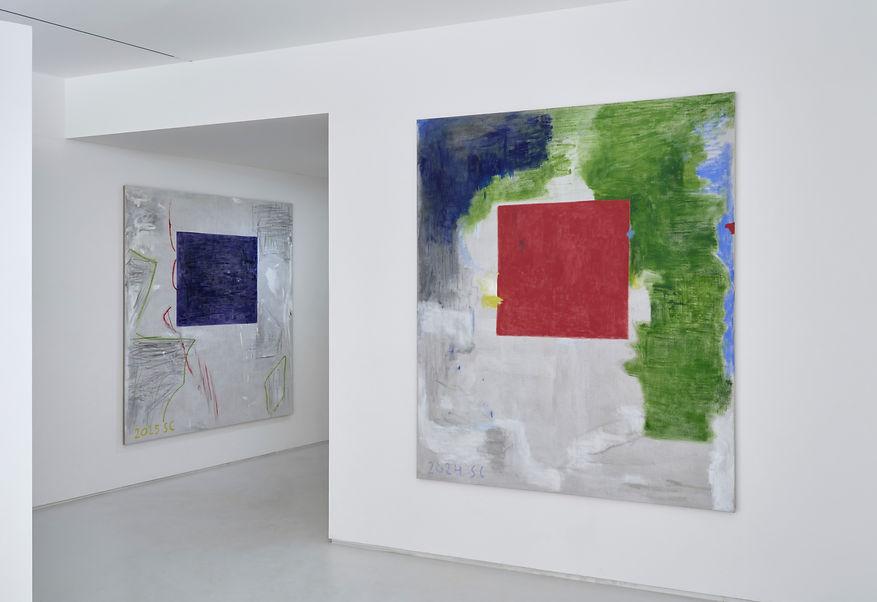
본 전시는 1층의 두 개로 분리된 공간과, 하나로 길게 이어진 지하 전시장에 걸쳐 구성된다. 1층에 설치된 회화는 크기가 제각기 다르지만, 모두 세로형 캔버스 중앙 상단부에 사각형의 형상을 배치하는 공통된 형식을 취한다. 이러한 형식적 질서는 구조적 균형을 확보함과 동시에 시선의 중심을 하나의 흐름으로 자연스럽게 수렴시킨다. 각 작품은 독립된 조형적 세계를 이루면서도 서로 은밀하게 연결되어, 보는 이로 하여금 시선과 심상이 뒤섞이는 흐름 속에서 추상적 관계를 유추하게 한다.
색의 영역은 작가에게 상징적 의미를 지니지 않지만, 대부분 자연에서 기억해낸 향수적 경험을 매개로 내면적 정서와 이어진다. 캔버스 전면에 드러나는 대기감은 작가의 작업 전반에 걸쳐 지속적으로 관찰되며, 이는 동양화의 특유의 습윤성을 기조로 구현된다. 본격적인 그리기에 앞서, 어두운 린넨 위에 묽게 칠한 젯소가 만들어내는 은은한 회색빛 수묵적 공간감 또한 이러한 맥락 속에서 이해될 수 있다.
층위가 다른 지하 공간에 설치된 작품들은 보다 유동적이며, 다양한 도형과 직관적 구성을 보여준다. 관람자는 감각과 사유를 따라 공간을 거닐며, 형식이 감각으로, 감각이 다시 형식으로 변주되는 경험을 마주할 수 있다. 이 전시 공간에서 정해진 시선이나 해석은 존재하지 않으며, 모든 형태와 의미는 오롯이 관람자의 정동 속에서 새롭게 생성된다.

Untitled, 2025, Oil on canvas, 100 x 80 cm
층위가 다른 지하 공간에 설치된 작품들은 보다 유동적이며, 다양한 도형과 직관적 구성을 보여준다. 관람자는 감각과 사유를 따라 공간을 거닐며, 형식이 감각으로, 감각이 다시 형식으로 변주되는 경험을 마주할 수 있다. 이 전시 공간에서 정해진 시선이나 해석은 존재하지 않으며, 모든 형태와 의미는 오롯이 관람자의 정동 속에서 새롭게 생성된다.
칸딘스키에게칸딘스키에게 ‘미의 형식미의 형식’은 외적 조형이 아니라은 아니라, 내면의 필연성이 외화된 정신의 언어였다언어였다. 그는 예술의 본질을 감각적 조화가 아닌그는 아닌, 정신의 울림이 형식으로 드러나는 과정으로 이해했다드러나는 이해했다. 이러한 관점에서 보면이러한 보면, 샌정의 회화 역시 형식 그 자체를 하나의 내면적 사건으로 드러낸다자체를 드러낸다. 그의 화면은 존재의 리듬이 교차하는 지점에서지점에서 ‘형식으로서의 아름다움형식으로서의 아름다움’을 다시 사유하게 한다을 한다. 작가의 작품을 통해 우리는 아름다움이 완결된 형태로 존재하는 것이 아니라우리는 아니라, 끊임없이 생성되고 소멸하는소멸하는 ‘존재의 사건존재의 사건’임을 인식한다임을 인식한다. 작가가 마음을 두고 남긴 흔적작가가 흔적, 곧 형식 그 자체는 감각의 언어로 확장되는 순간을 보여준다자체는 보여준다.
“순수한 형식을 관조하는 것은 우리의 정신을 특별한 고양된 상태로 이끌며순수한 이끌며, 삶의 현실로부터 완전히 분리된 상태에 도달하게 한다삶의 한다.” 2
_____________________________________________________________________________________________
1. “선과 색이 특정 한 방식으로 조합되어 있고, 특정한 형태와 형태 사이의 관계가 우리의 미학적 감정(aesthetic emotion)을 자극한다. 이러한 선과 관계의 조합, 즉 미학적으로 감동을 주는 형태들을 나는 "의미 있는 형식(significant form)" 이라고 부른다.” 클라이브 벨, Art, 안영주 옮김, 퍼플, 2025.
2. 클라이브 벨, Art, 안영주 옮김, 퍼플, 2025.

Untitled, 2024
Wall painting (detail)

To follow the square forms in Sen Chung’s paintings is to allow for a quiet assimilation into the image. The recurring motif of squares in his works serves as a formal apparatus that explores the relationship between the imaginary and the reality of existence. The squares evoke the transitory service of a door or frame, closing a world while opening into another. Within the space of the square, form becomes a manifestation of freedom within discipline, change within stillness, and openness within closure.
Over the years, Chung has devoted his practice to formal and conceptual experimentation of painting, arriving at abstraction through an inquiry into beauty as form and the fundamental flatness of the medium. The process by which the artist’s inner world engages with the materialisation of form is abstracted and takes shape as an internal event in the canvas. Through its formal exploration, Beauty as Formalism traces the allegorical meanings beyond the visible through Sen Chung’s fifteen paintings created between 2023 and 2025. What follows addresses the questions that underpins Chung’s practice, exploring the essence and potential of the aesthetic decisions the artist makes.
Significant Form 1
Clive Bell defines “significant form” as the particular arrangement and relationship of forms within an artwork that evokes an emotional response, what Bell called the “aesthetic emotion”. The term “significant form” refers to how individual formal elements interact in order for the viewer to produce an aesthetic emotion viewer, and does not refer to an overall appearance
of an artwork. Here Bell describes that an artwork’s quality arises from relationships amongst its formal elements, rather than its representational content. Elements of line, color, shape, proportion, balance, rhythm, and spatial composition serve as parts that, once placed together, induce a complete viewing experience.
Bell’s concept extends Immanuel Kant’s ideas about “purposiveness without purpose” from the Critique of Judgment. Kant's argument is that the judgment of beauty comes not from a utilitarian function but rather from a formal harmony that only appears to serve a purpose. In this sense, Kant shares Bell’s perspective that an artwork has no purpose external to its own aims. Instead, it generates pleasure through the self-contained logic of its completeness. Ultimately, for both Bell and Kant, the essence of art lies not in what it represents, but in how it exists. They saw art as an autonomous realm of form and the self-conscious acknowledgement of the emotions that emerge from experiencing it.

Untitled, 2024, Oil on canvas, 200 x 170 cm
Bell’s “significant form” and Kant’s “purposiveness without purpose” provide an important framework for understanding Sen Chung’s work. Rather than foregrounding narrative or explicit themes, Chung reconstructs sensory order through the atmospheric interplay of color, form, texture, and space. Sen Chung's works– where forms are inseparable from the feelings lent to it– propose an autonomy of the aesthetic experience through formal ordering that transcends meaning. The viewer can be absorbed into the space composed by the artist.
This exhibition unfolds across two gallery spaces on the ground floor and a fluid gallery space on the basement floor. Though varying in size, the paintings installed on the first floor all share a recurrent composition: a rectangular shape centrally positioned in the upper half of a vertical canvas. Through both its structural balance and collective display, these works centre around the motif of the square, their ordered patterns guiding the viewer’s perception and movement within the space. The viewers are free to assemble for themselves the relationships between the paintings. The works installed in the basement space contain a more fluid form, with a greater variety of shapes and more intuitive compositions. In intuitively responding to the works, viewers are guided through the space by their own affect. Sen Chung prescribes no fixed way of seeing or interpretation, aiming instead for meaning to emerge through the viewer’s own response.
“The contemplation of pure form leads to a state of extraordinary exaltation and complete detachment from the concerns of life.”. 2
For Sen Chung, the realm of color holds no symbolic meaning. The colours instead relate to the artist’s nostalgic experiences of nature and how its atmospheric qualities permeate the painted surface. These subtle tonal shifts, characteristic of traditional East Asian ink painting, have become a recurring element in Chung’s practice. The muted pond-gray depths are created through a thin layer of diluted gesso brushed over dark linen, softly emerging through layers of oil paint can also be understood within this context.
For Kandinsky, the “form of beauty” was a spiritual language that externalizes an inner necessity. He understood the essence of art as the process through the spiritual is expressed through form. When shown together, Chung’s paintings establish a presence, a rhythm of interconnectedness that invites a broader reflection on how beauty is given form. Chung’s works present beauty as neither a fixed nor finished form, but as a continually shifting horizon, or a project of becoming. For Sen Chung, the making of the painting is an event in which the inner self is revealed through form.
________________________________________________________________________________________________________________________________________________________________________________________________
1. “Lines and colours combined in a particular way, certain forms and relations of forms, stir our aesthetic emotions. These relations and combinations of lines and colours, these aesthetically moving forms, I call Significant Form”. Clive Bell, Art, trans. by Young-ju Ahn, Pubple, 2025.
2. Clive Bell, Art, trans. by Young-ju Ahn, Pubple, 2025.


